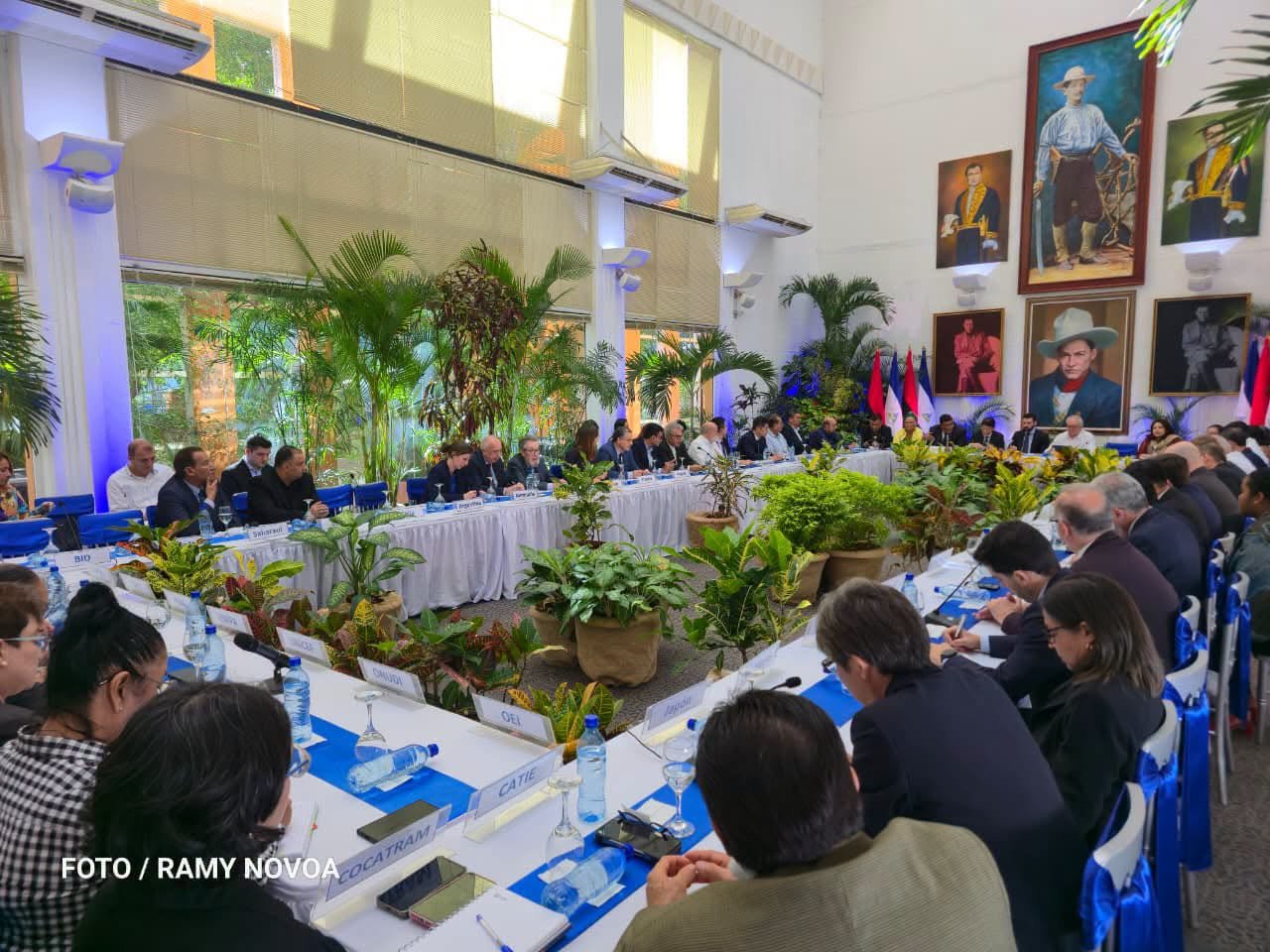
Nicaragua’s Foreign Ministry held a meeting with the foreign diplomatic corps on Monday. In the meeting, President of the National Assembly of Nicaragua, Dr. Gustavo Porras, clarified that the National Assembly is carrying out a constitutional reform process which aims to pass reforms on elections in early September, for the Mes de Patria. The Foreign Ministry reported “an amicable meeting and exchange between [Nicaraguan] authorities and the diplomatic corps and accredited missions on the organization of our sovereign electoral processes”. Below is a transcription of the meeting.
Introductory remarks by Compañero Valdrack Jaentschke, Co-Foreign Minister of Nicaragua
We appreciate your presence, we appreciate the response you have given to this meeting. It’s a long time since we have seen each other in this format. And I think it’s quite a useful format for us to share information.
Without further ado, Doctor Porras, I give you the floor.
Address by Dr. Gustavo Porras, President of the National Assembly:
Thank you. Good afternoon, everyone. Good afternoon to the Compañeras and Compañeros of the Government, to the Brothers and Sisters of the Government and to everyone present.
Thanking you for your participation, your presence which allows me to explain to you this task that we have set of a Constitutional Reform to guarantee our Principles of Democracy, Sovereignty and Self-Determination, and which allows us to guarantee the conditions to continue the fight against Poverty that we have undertaken.
We greet you all and I want to express to you, probably what is a reiterated, well-repeated, but absolutely indispensable matter. Because, based on the speech of Co-President Comandante Daniel Ortega, a number of interpretations were made such that it is important to clarify that we will comply with this approach faithfully and, moreover, in the best possible way.
I understand that a democracy is determined by respect for the laws and respect for existing legal procedures, and that the fundamental Law, the Law that determines the entire order of a country, in each of your countries, is the Constitution of the Republic. And that what the Constitution dictates is what all citizens should do.
In Comandante Daniel’s speech, there is a part that says: “But they can forget that, there will be no such elections here again, there will be no elections again for them to try and cheat their way to government, cheat their way to power in that way. And we are going to work, with the National Assembly and with the corresponding institutions, on the Law, because we have to make laws that put a wall, a barrier against the coup plotters, the sell-outs, such that no matter how much money the Yankees give them, they won’t prevail! They Won’t Prevail! They Won’t Be Able To!”.
With this mandate and also given our History, with the Spirit of our Principles and the Nicaraguan Sandinista Spirit, although as you can see we are from the different political parties here, but the Sandinista Spirit is gradually becoming the Nicaraguan Spirit. Because Sandino today is the expression, along with Darío, Nicaraguans’ strongest expression.
Such that in this way we will work on a Constitutional Reform in relation to which it should be clear that there will be elections. Because I’m clear that this is the concern. There are going to be elections. Indeed, as there are elections. Nicaraguans, with our Spirit of Sovereignty and Self-Determination, we are going to make elections of the Nicaraguan People, for the Nicaraguan People and in accordance with the reality and history of the Nicaraguan People. And we want to guarantee: There will be elections!
Naturally, as in all countries, probably in your countries too, there are certain conditions for those who participate in electoral processes, certain requirements for those who want to participate in electoral processes.
And in our country we are studying, we are looking at Constitutional Reforms which allow us to ensure free, democratic, transparent Elections, but ones with the conditions to guarantee stability, security and Peace, which are essential elements for combating Poverty.
Probably some of what I am going to read here is not alien to you, because probably in many countries it may well exist; but part of the Reform is to do with those who exercise or have exercised the direction, leadership, financing, direct or indirect participation, or any type of connection with the planning, preparation or execution of an attempted coup d’état or a consummated coup d’état and will not be able to be candidates for positions of popular election, nor will they be able to hold public office by electoral appointment nor the Presidency.
I do not know if there may be some country where someone will attempt a coup and afterwards… But even if there is not, it doesn’t matter. Now, we do intend to establish in our Constitution that someone who has attacked Nicaragua’s revolutionary order and also those who commit or have committed acts that undermine Nicaragua’s Independence, Sovereignty and Self-Determination; who incite or promote foreign interference; who seek the political right to military intervention; or organize with financing from abroad; or propose, manage or support economic, commercial or financial blockades and sanctions against the State of Nicaragua, its Institutions and its Citizens. That’s very clear, that’s why I said to you, it’s probably not something unusual.
So the proposal we have or are going to have is to raise this to a Constitutional level. That is the proposal, to give it strength, to establish that Constitutional barrier so that someone cannot be a candidate for some office in Nicaragua, raising the banner of military intervention against us. That cannot be, that is unacceptable.
So, in essence that’s it, and the leading Reform of these aspects, naturally, as in every country, is that anyone who violates the Constitution cannot stand, because how are you going to violate the Constitution of the Republic and stand as a candidate in the country?
So, I want to convey to you, in a considered way, that this is the objective of our Reform. Above all, it is to guarantee Democracy, it is to guarantee free elections, without foreign interference; it is to guarantee Elections where there is no external financing; it is to guarantee absolutely democratic elections for the Nicaraguan people.
As working diplomats you certainly know the history of our country very well. In our country there were, at one point, occupying troops who became the Supreme Electoral Council, and there were occupation troops whose officers were presidents of polling stations, back in the 1930s. We have to learn from that history. There were ambassadors to our country who went around doing political campaigning and delivering food packages, in an electoral campaign with a candidate by their side. We have to learn from that history. That is not a free election, that is not a free Democracy.
Or the best example we have is that of the 1990 election, when Nicaraguans had, both figuratively and I would say literally, a gun to their head: “If the Sandinistas win the elections, the war will continue.” And the People are intelligent, and our People taught us that we had to look for Peace. And we understood that. And even with imposed outcome, Comandante Daniel handed over the government. Because we realized, because we understood that the most important thing was Peace.
I remember that Comandante Daniel said, “And we are going to return to government by way of elections,” as in fact we did in 2006-2007.
That is to say, in Nicaragua the political sectors, the Sandinista Front and the other political parties that accompany us in the Assembly, have learned to deal with democracy, but in a good way. And we have worked and struggled and made our way so as to develop this Model that is gradually becoming established, which is the model of the People President. It is a model of the People’s protagonism.
So, in order not to bore you with the story, the first conclusion or the first message is: Yes, there are going to be Elections! Yes, these are going to be Democratic elections! As elections under Sandinista Governments or being Sandinista Governments have always been, after all. Those elections could not have been more democratic, the one in 1990, the one in 2006-2007, absolutely democratic! And all the elections thereafter. And what we are looking for is how to ensure that they are increasingly clearer, more transparent, more democratic, and with fewer machinations from individuals, produced overnight, to confound Nicaragua’s democratic process. That’s the first thing we have to be clear about and which we want to convey to you.
And so there you are, in fact, I might have dared, although I did not actually do so, to read out all of the things that we are discussing right now… I did read some and perhaps my Compañeros and Compañeras might call me to account. But that’s the sense. These are the retaining walls. In other words, if someone here is not Nicaraguan or, moreover, is a traitor to our Patriotic Nation, is such a traitor to the Nation to participate in a Democratic Electoral Process in any Country? I think not. If someone violates the political Constitution of their country, or any of the things I have mentioned here, then they do not participate.
On the other hand, the Electoral Reform also touches on, because this must be guaranteed, that the Supreme Electoral Council is the entity that has the function, the attribution of executing these electoral elements. So, part of the Reform is, in an article relating to the powers of the Supreme Electoral Council, it will say that one of the powers has to do with denying legal personality in the case of political parties that want to present candidates that the Constitution does not allow; or in the case of canceling the candidacy of people who are within these various prohibitions that are established. Then the Supreme Council is to be empowered to do that.
There is another point that we are only just discussing within the Commission, this explanation to you is an explanation that was prepared before starting the Consultation Process that starts tomorrow and which is going to be a Process that is going to take us the whole month of August, because we have in our mind, our idea is to approve this in the month of the Patriotic Nation, at the beginning of the Month of the Patriotic Nation, which is the month of September. But we are going to carry out what I would say is a very extensive Consultation Process throughout the month.
And thus we are going to consider other aspects as well. For example, the aspects that have to do with duration. We have a certain duration for the elections, six years. Here we have to see if that can be modified or not, or if it should be modified. We think that it is necessary to establish a duration allowing us stability, security and Peace, because we have only one enemy, which is Poverty, and we have to guarantee electoral periods that allow us to develop work, efforts, projects, initiatives, in that fight against Poverty. But we still have no definite duration, in the sense that we are discussing.
Some countries have ten years, other Countries have seven. Quite a few countries have seven. Other countries have six years. There are other countries with five. Recently some countries went from five to six years. We had gone from five to six, in a Constitutional Reform last year. And there are countries that have four years, which often become eight. It’s like saying we want eight but let’s not make it eight, but make it four plus four. I mean, all of that exists.
We are going to discuss what is in Nicaragua’s interest. This is a discussion for Nicaraguans to see what is convenient for Nicaragua given our history, given our possibilities, given our projects, according to our vision, for the benefit of our People.
However, without a doubt, it is of great importance for us to have you here, because when diplomatic representation is established and when international organizations are established with their delegates and we are clear that there is friendship, and we respect all our friends who are respectful to us, then the least we can do is provide you with the information that we have defined at the moment.
Are there going to be elections? Yes. Are the elections going to have the kind of intention mandated by the President? Yes, that is to say, absolutely fair, necessary and nothing unusual. We are going to study the electoral periods and there are also some articles of the Constitution that we must modify for the operational part of decision making, such as what I explained to you about the Supreme Electoral Council or how there may be a need to change something, in the event that there was a change of duration, of the electoral period, meaning we have to change what exists at this moment.
That is it in essence, and rather, as we are all here, the members of the Special Constitutional Commission have already been presented to you, if there are any doubts, any concerns, we are at your disposal.
Thank you.
Compañero Valdrack Jaentschke:
Thank you very much, Doctor, for that clear statement.
Indeed, it is important to emphasize that the members of the National Assembly present, as well as the members of the Board of Directors, are also members of the Special Advisory Commission on this issue. That is why we see members of different political movements, members of the different parties that make up this Special Commission.
We leave the microphone open to see who would like to comment, or ask questions, I think rather for question. Let’s limit it to questions. Thank you very much. Do just raise your hands, you have microphones to hand, do share them.
What clarity, Doctor, absolute clarity in your presentation. Not the slightest shadow of doubt in your presentation. The cameras have gone now.
Compañera of the Inter-American Development Bank.
Remarks by Mrs. Shirley Cañete Romero, Representative of the Inter-American Development Bank (IDB)
First of all, thank you for this meeting. I think it is important for us to receive first-hand information from you, and that as Doctor Porras has well informed us, that you are going to start a consultation process and that process has several points.
So, maybe we should be grateful for the opportunity to have these meetings back-to-back and we can have such first-hand information rather than the information we end up reading in the media, so that we can clearly inform our respective agencies and embassies. So, thank you very much for all this information that you have just provided us and hopefully we can be part of this process, so that we can understand how Nicaragua’s elections are progressing.
We also do not know the date, but we understand that it may be, in that regard, towards next year. Thank you.
Compañero Valdrack:
Thank you, Representative.
Mr. Fernando Ponz, Ambassador of the European Union:
Well, good afternoon and once again, thank you for this amicable meeting. On behalf of the Member States of the European Union and myself, I would like to thank you very much for this presentation, which is in the spirit of dialogue and helps us to understand things better.
As part of the Reform that you have presented to us, I would like to take this opportunity you are giving us, and always with the utmost respect for the Nicaragua’s national Sovereignty, to ask you if you intend to organize some kind of independent observation of the upcoming elections. And, of course, I reiterate, this is from the most absolute respect in relation to this decision that belongs to you.
Once again, thank you for this friendly meeting. As our colleague said, it is a format that we hope will continue, we thank you, since it is a format that allows us to have a dialogue, increase transparency, get to know your points of view first-hand and all out of the utmost respect, a mutual respect. Thank you.
Compañero Valdrack Jaentschke:
Thank you, Ambassador Ponz.
We are going to ask two, three, four, five questions and then we can give the floor to Dr. Porras.
Anyone else?
Dr. Gustavo Porras:
Well, we must recognize the importance of these get togethers, of these spaces, it is up to us to inform you, as a point of reference and in the spirit of friendship Nicaraguans have with all those who respect us.
Right now we are working on what the Constitutional Reform will be, and I encourage you to convey the decision, the tranquility, the sovereign decision, the explanation, we might say, that in this country there are going to be elections as there have always been in recent years. Explaining a little the history of how they used to be and how we don’t want them to be again. And this is to communicate the concern that we have and the discussion that Nicaraguans are having, to carry out this process. And what we are doing are constitutional reforms that guarantee this. I’ve already read the other relevant part.
Now, our elections have always been observed, accompanied, we call it, because they really are accompanied, and they will continue to be so, because the elections here are absolutely democratic.
You can be sure that I thank Ambassador Ponz for his question, because it is a question that takes us further on, that is to say, that the discussion is no longer about whether or not there are elections, which was the discussion that existed up until now; now the question is whether or not there will be accompaniment. But we are now where we are, clear that we are in a process, we are listening, we have collected concerns and are paying attention to friendly requests for information. We will continue to inform you how this process is going and little by little the data will be more concrete, obviously, because right now we are just going to start the process. Do let’s communicate that.
And be assured that the Nicaragua’s People will support this process and will also accompany the elections of Nicaraguans, for Nicaraguans.
Compañero Valdrack Jaentschke:
Thank you very much, then, for having participated in this effort, and I think that Dr. Porras’ presentation has been crystal clear and absolutely informative. I’m not going to venture to repeat it, because it was clear and informative, and I think also that the two comments were of a very high quality, in the sense that they helped complete the snapshot; we hope that this will be the photograph that is transmitted of what Doctor Porras has said so forthrightly.
Nicaragua, a country, I’m going to repeat it, Doctor, a democratic country, with democratic elections, where we defend our process and our model and where there are going to continue to be elections. And as we have organized this process, we will continue organizing it, with quality, but fundamentally responding to our Nicaraguan People, to Nicaragua’s interests, to the defense of Nicaragua’s Model, the defense of Nicaragua’s Democracy of Peace and Well-being. I think the Doctor may well tell me off for paraphrasing him, but I think that’s clearly what the Doctor explained and what the purpose of this meeting has been.
If someone, after all this exchange, feels an urgent need to ask another question or make another comment, we will leave the next few seconds for them to decide… Since there are only smiles, then we are going to conclude this meeting, thanking you again for your presence, thanking you for your willingness to accompany this process, to be kept up to date, and also thanking you for transmitting this information as we have provided it to you. You know what we are doing now, we don’t need to explain more, and you also are communicators of this vital information.
Thank you very much. Good afternoon.